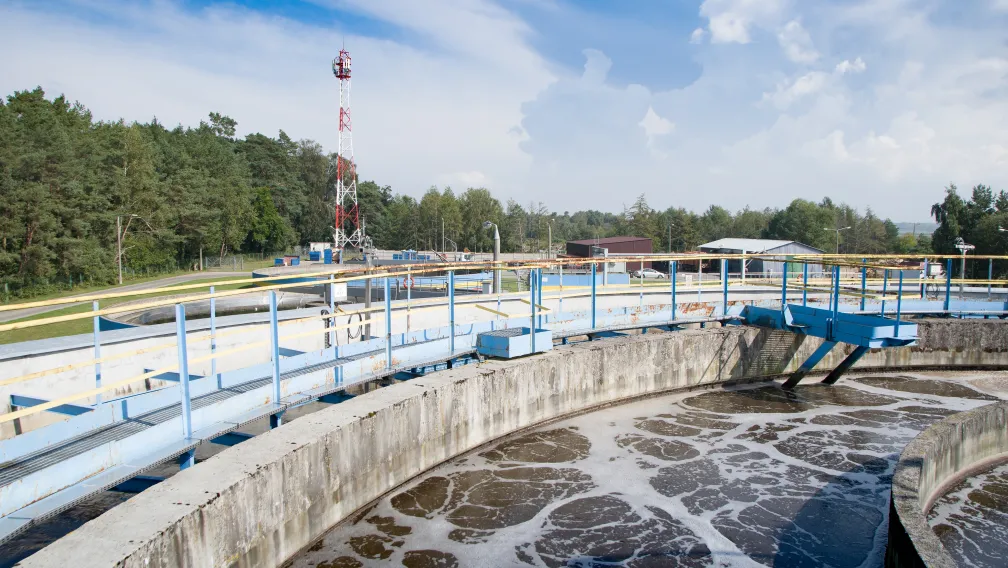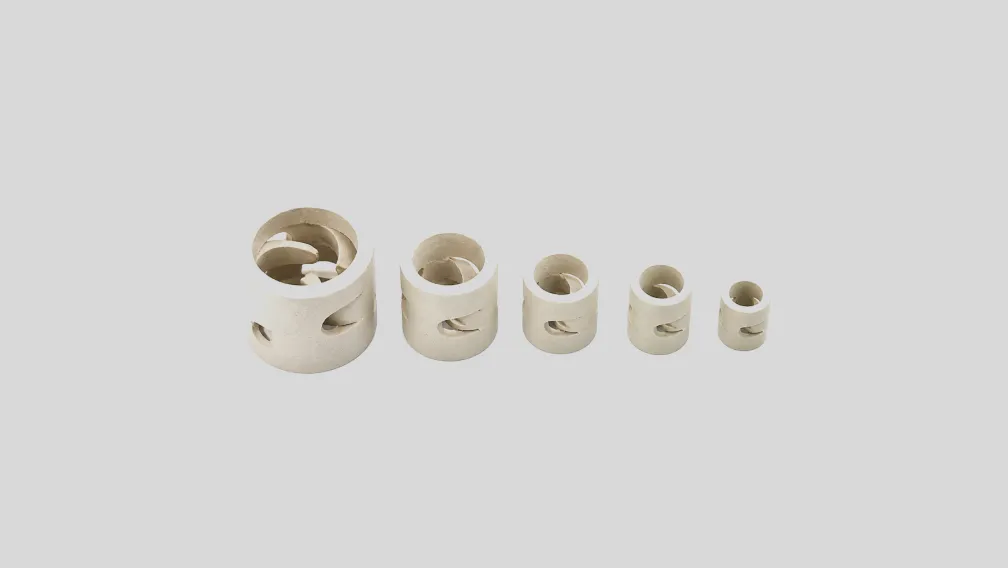

MBBR turns up in almost every wastewater tender and media catalogue these days, usually with no explanation attached. The idea behind it is simple: grow the bacteria that clean the water on small plastic pieces that float and tumble inside the tank, so the bugs stay put instead of washing away. This guide covers what MBBR is, how the process runs step by step, what the carriers do, how it compares with activated sludge, IFAS and MBR, and where plants actually use it. We manufacture the carriers, so the figures here come from what we see in the field.
What is MBBR?
MBBR stands for Moving Bed Biofilm Reactor. It is a biological process for treating wastewater in which the microorganisms that break down pollutants grow as a biofilm on thousands of small plastic carriers moving freely inside an aerated tank. Professor Hallvard Ødegaard developed it at the Norwegian University of Science and Technology in the late 1980s, and it now runs in more than fifty countries, from small packaged units to large municipal and industrial plants.
The whole method hinges on one thing: the biomass lives on the carriers. Holding it there is what keeps the tank compact and steadies the process when the incoming load swings.
How MBBR works, step by step
An MBBR tank looks a lot like a standard aeration tank, with one change: part of its volume is filled with plastic biofilm carriers. Here is what happens inside.
- Carriers fill part of the tank. Thousands of small HDPE pieces go in, usually filling 40 to 70 percent of the volume, with most designs near 50 percent. Their density sits just under water, so they stay suspended and circulate.
- Aeration keeps them moving. Air blown in from the floor, or a mechanical mixer in anoxic zones, keeps the carriers tumbling through the whole tank. The same air feeds oxygen to the bacteria (aerobic zones run at 2 to 4 mg/L dissolved oxygen), and the turbulence scrubs off surplus growth so the biofilm stays thin and active.
- Biofilm grows on the sheltered surface. Bacteria colonise the protected inner surface of each carrier and build up a film. Because they are held on the media, they ride out the flow instead of washing downstream.
- The bacteria treat the water. Heterotrophic bacteria consume the organic load, measured as BOD and COD. Nitrifiers oxidise ammonia to nitrate. In anoxic zones, denitrifiers convert that nitrate to nitrogen gas, which leaves the water.
- A screen holds the carriers back. A sieve at the outlet, sized smaller than the media, keeps carriers in the tank while treated water moves on, usually to a clarifier or settling step.
A plant can run a single MBBR stage for straightforward organic removal, or several aerobic and anoxic stages in series when nitrogen also has to come out.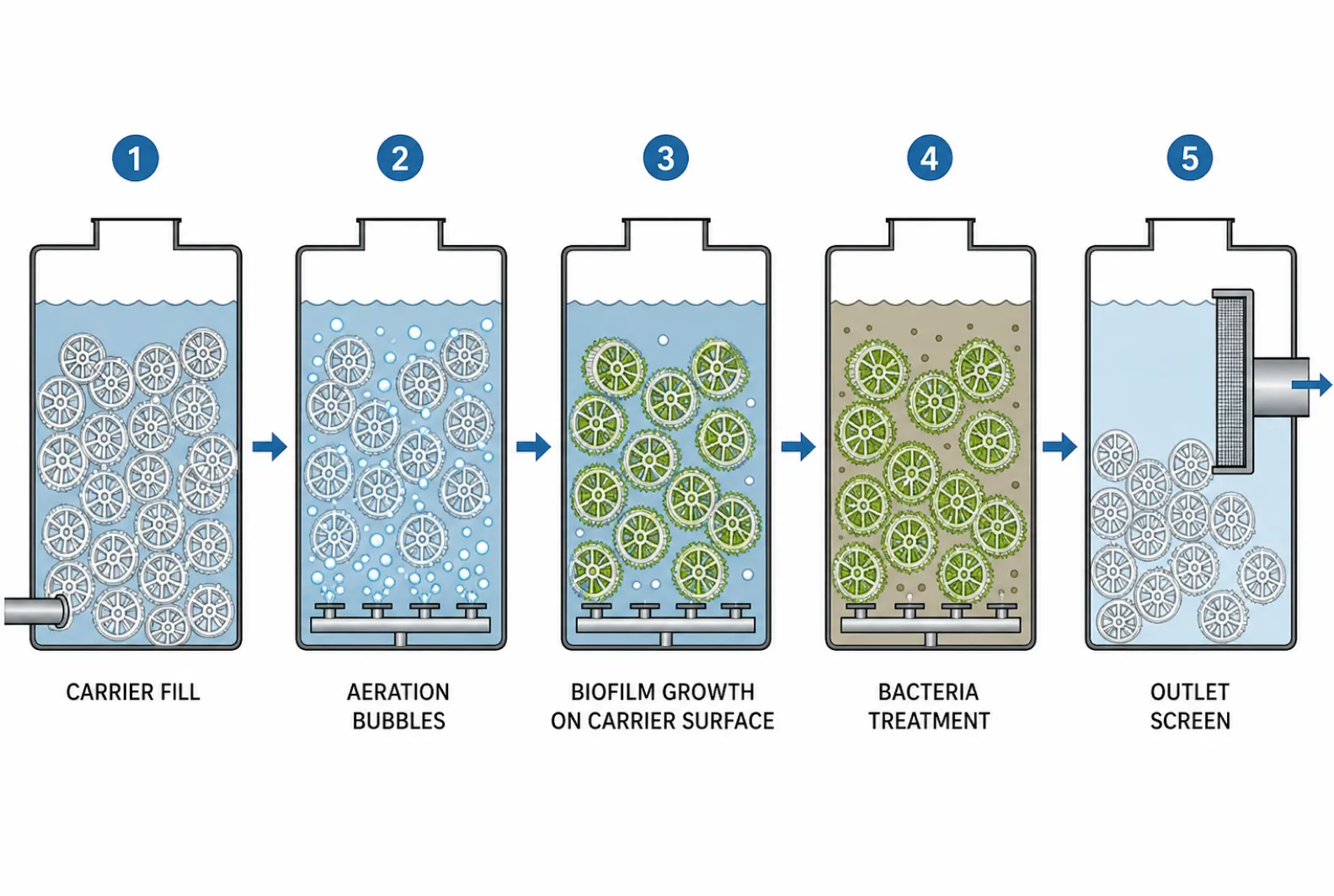
The carriers are the heart of the system
Everything in an MBBR comes back to the media, so it pays to understand them. A carrier is a small plastic element, almost always virgin HDPE, shaped to pack a large sheltered surface into a small volume, so plenty of biofilm can grow where the tumbling cannot scrub it off. Density sits just below water so the pieces circulate on ordinary aeration, and good HDPE carriers run 10 to 20 years before they need replacing.
Two numbers decide how a carrier performs:
- Protected surface area. This is the area where biofilm actually survives, once you subtract the raised edges that take the brunt of carrier-to-carrier and carrier-to-wall collisions. It counts for more than the raw total area. A classic K1 carrier offers roughly 500 m²/m³ of protected surface; denser and porous designs push effective area past 1,000 m²/m³, which fits more treatment into the same tank.
- Fill ratio. The share of tank volume taken up by carriers. More carriers mean more biofilm, up to a ceiling around 65 to 70 percent. Past that, the pieces crowd each other and stop circulating cleanly, so most plants sit between 40 and 60 percent.
Matching surface area and fill ratio to the pollutant load is the heart of MBBR sizing, and it is a job in its own right. We walk through it in our guide to selecting water treatment media. The K1-type carrier is the usual starting point; from there we move up to higher-surface-area or bio-ball designs when the load or the tank calls for it. The full range is on our MBBR media page.
Typical MBBR operating parameters
| Parameter | Typical range |
|---|---|
| Carrier fill ratio | 40–70% of tank volume (often ~50%) |
| Protected surface area | ~500 to 1,000+ m²/m³ |
| Dissolved oxygen (aerobic zone) | 2–4 mg/L |
| Hydraulic retention time | 1–8 h (3–6 h for nitrification) |
| Organic loading rate | 1–5 kg BOD/m³·d |
| BOD removal | commonly 90–95% |
| Carrier service life | 10–20 years |
Treat these as starting points. The right values track your influent strength, temperature and discharge target.
MBBR vs activated sludge
Activated sludge is the older standard. It grows its bacteria as loose flocs floating in the tank, settles them out in a clarifier, and pumps a share back to keep the population up. MBBR came out of two weak spots in that setup: it leans hard on good sludge settling, and it struggles when the load spikes. Anchoring the biomass on carriers takes the sludge-return loop out of the picture and holds the bacteria in place through shocks.
| Point | MBBR | Conventional activated sludge |
|---|---|---|
| Where the bacteria grow | Biofilm on floating carriers | Loose flocs suspended in the water |
| Sludge return line | Not needed | Required |
| Footprint | Compact | Larger |
| Resilience to shock loads | High | Lower |
| Excess sludge produced | Less | More |
| Raising capacity | Add carriers, no new tanks | Usually needs more tank volume |
| Reliance on the clarifier | Low | High |
In practice, MBBR treats the same load in a smaller tank, shrugs off sudden or toxic loads, makes less waste sludge, and does not live or die by the clarifier. Those same traits make it a favourite for upgrades: tip carriers into an overloaded activated-sludge tank and its capacity climbs without building anything new.
MBBR vs IFAS
IFAS, short for Integrated Fixed-Film Activated Sludge, comes up alongside MBBR constantly, and the two are easy to confuse because both use biofilm carriers. The split is one line on the flow diagram. IFAS is an activated-sludge plant with carriers dropped in and the sludge-return line kept, so suspended flocs and attached biofilm work side by side in the same tank. MBBR keeps no sludge return, and all the working biomass sits on the carriers. IFAS helps when you are squeezing more capacity out of a plant that already has clarifiers and return pumps. MBBR is the simpler, self-contained choice for a new build, or when you want to drop the sludge loop.
MBBR vs MBR
MBR, the membrane bioreactor, reaches the same goal by another path. It pairs biological treatment with a membrane that filters solids and microbes straight out of the water, so it needs no separate clarifier and turns out very clean effluent. The trade-off is cost: membranes are expensive to buy, they foul over time, and they need regular cleaning and eventual replacement. MBBR uses floating carriers and a downstream settling step for lower capital cost and simpler operation, giving up a little effluent polish in exchange. Where discharge limits demand membrane-grade water, MBR earns its place; for most BOD and nitrogen duties, MBBR does the job for less.
Advantages and limitations
MBBR earns its reputation, and both sides are worth seeing.
Advantages
- Smaller footprint, because the biomass is concentrated on the carriers.
- No sludge recirculation, and performance does not ride on the clarifier.
- Handles hydraulic and toxic shocks well, with a self-regulating biofilm.
- Strong nitrification, and less excess sludge to remove.
- Simple to retrofit: add carriers to raise an existing tank's capacity.
Limitations
- Higher upfront cost, mostly the carrier media itself.
- Retention screens have to be sound, or carriers wash out with the flow.
- Good biological control needs operators who understand biofilm, and the biomass is hard to monitor continuously.
Where MBBR is used
MBBR shows up right across wastewater work. Municipal plants use it for BOD removal and, with staged aerobic and anoxic zones, for nitrogen removal. Industry runs it on high-strength effluent from food, beverage, chemical and pharmaceutical producers, often as an MBBR stage ahead of a polishing step. It suits aquaculture and recirculating fish systems, where a compact, steady biofilter keeps water quality up. And it is a standard fix for an overloaded plant: dial the carrier fill up to the capacity you need. A small footprint plus tolerance for moving loads is why it fits so many sites.
Where Rongjian fits
We manufacture the biofilm carriers an MBBR runs on: K1-type and other MBBR media, along with the bio balls, tube settler media and filter media that complete a full treatment train. Our carriers ship to municipal and industrial plants in over a hundred countries, made from virgin HDPE for the 10-to-20-year service life the process needs.
Planning an MBBR, or adding carriers to an activated-sludge tank? Send us the flow, the load and the effluent target, and we will recommend the media type, protected surface area and fill ratio to hit it. Reach us through the enquiry form or your Rongjian contact for advice or a quotation.
Frequently asked questions
What does MBBR stand for, and what is it?
MBBR stands for Moving Bed Biofilm Reactor. It is a biological wastewater process in which the bacteria that break down pollutants grow as a biofilm on small plastic carriers that float and tumble in an aerated tank, so the biomass stays in the reactor and keeps working when the load changes.
How does MBBR work?
Plastic carriers part-fill an aerated tank. Aeration keeps them circulating, supplies oxygen, and shears off surplus biofilm. A film of bacteria grows on the sheltered surface of each carrier and treats the water: heterotrophs remove BOD and COD, nitrifiers turn ammonia into nitrate, and in anoxic zones denitrifiers turn nitrate into nitrogen gas. A screen at the outlet holds the carriers back while treated water passes on.
What is the difference between MBBR and activated sludge?
In activated sludge the bacteria float as loose flocs that have to be settled out and partly returned to the tank. In MBBR they grow fixed on carriers, so there is no sludge-return line, the biomass cannot wash out, the tank runs smaller, and the process copes better with shock loads while producing less waste sludge.
What is the difference between MBBR and IFAS?
IFAS is an activated-sludge process with biofilm carriers added and the sludge-return line kept, so suspended flocs and attached biofilm treat the water together. MBBR has no sludge return, and all the working biomass lives on the carriers. IFAS fits plants that already have clarifiers and return pumps; MBBR is the simpler, standalone process.
What is the difference between MBBR and MBR?
MBR pairs biological treatment with a membrane that filters out solids and microbes, giving very clean effluent with no separate clarifier, at higher cost and with fouling to manage. MBBR uses floating carriers and a downstream settling step, which costs less to build and run with slightly less effluent polish. MBR suits the strictest discharge limits; MBBR handles most BOD and nitrogen duties for less.
What is MBBR media made of?
MBBR carriers are made of plastic, almost always virgin high-density polyethylene (HDPE), shaped to hold a large protected surface where biofilm grows undisturbed. Their density sits just below water so they suspend and circulate on ordinary aeration, and good HDPE carriers last 10 to 20 years. The K1 carrier is the common baseline design.
What fill ratio should an MBBR use?
Most MBBR tanks run a carrier fill of 40 to 70 percent of tank volume, with around 50 percent typical. The practical ceiling is 65 to 70 percent; pack in more and the carriers crowd each other and stop circulating properly. The right figure depends on the pollutant load and the carrier's protected surface area, so sizing is done case by case.
How long does MBBR media last?
Quality MBBR carriers made from virgin HDPE last 10 to 20 years in normal service. Lifespan drops when the media is made from recycled plastic, or where abrasion and harsh chemistry are severe, which is one reason virgin HDPE is worth specifying.
What can MBBR remove from wastewater?
MBBR removes organic pollution, measured as BOD and COD, and it handles nitrogen: nitrifying bacteria convert ammonia to nitrate, and in anoxic zones denitrifiers convert nitrate to nitrogen gas. Well-run systems commonly reach about 90 to 95 percent BOD removal, and multi-stage designs cut nutrients further.
-

BrandName Team
Process Media Manufacturer Since 2010
Rongjian produces tower packing, molecular sieves, ceramic grinding media and other process media from our Pingxiang production base. We supply to industrial projects in over 100 countries.