
On 5 May 2026 Germany opened the 2026 bidding round of its Carbon Contracts for Difference scheme, worth up to €5 billion, and for the first time carbon capture and storage or utilisation (CCS/CCU) projects can take part. The European Commission cleared the programme under state aid rules two days later. It is one of Germany's largest industrial-climate measures, and for anyone who supplies the hardware inside capture plants, it points one way: more absorption columns getting built, and steady demand for what goes inside them.
What the scheme covers
Germany runs the programme, recently rebranded from "climate contracts" to CO2 Contracts for Difference, as a competitive reverse auction. Its main features:
- Up to €5 billion in funding, awarded as 15-year contracts that cover the cost gap between low-carbon and conventional production. If the clean route later turns cheaper, the company pays the difference back to the state.
- Open to energy-intensive sectors: chemicals, metals, cement, lime, glass, paper and ceramics.
- CCS and CCU projects allowed for the first time, where they tackle process emissions or emissions that are hard to avoid, such as those from making cement.
- Binding targets: at least a 50 percent emissions cut against the baseline by year four, and at least 85 percent in the final contract year.
- State-aid approval from the European Commission on 7 May 2026, which called the support "necessary and appropriate."
The first round, back in October 2024, ended with fifteen successful companies. This one arrives after months of criticism over delays that had left industry short on planning certainty.
Part of a wider push
The auction is one piece of a broader European move on industrial carbon. Germany has reformed its storage law to allow CO2 to be transported and stored, clearing a legal path that capture projects need. At EU level, the Industrial Carbon Management Strategy is pulling capture, transport and storage into a single framework, while offshore storage hubs and cross-border CO2 shipping take shape across the North Sea. The direction is consistent: hard-to-abate sectors like cement, steel and chemicals are being steered toward capturing the CO2 they cannot yet design out.
What it means for process-media suppliers
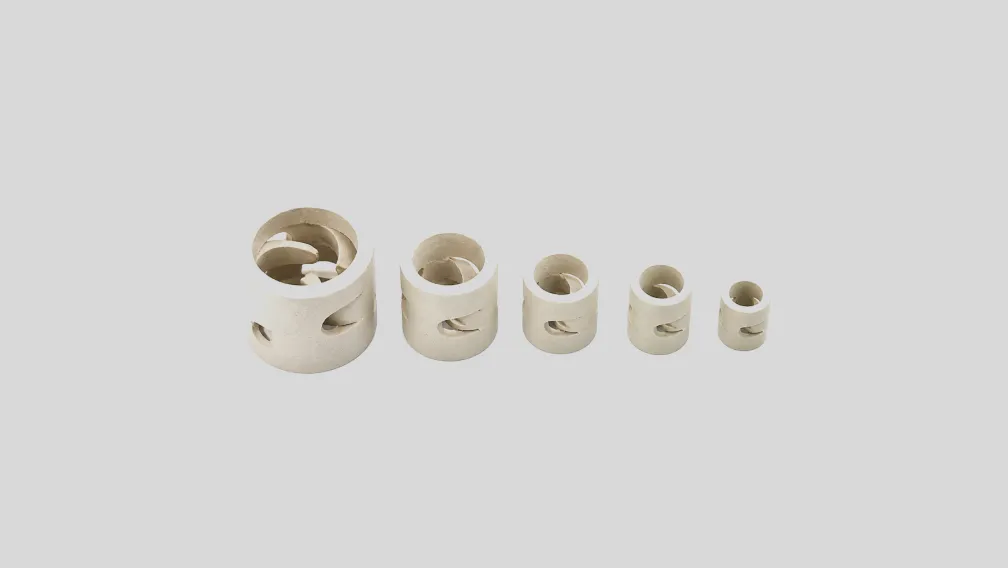
Pulling CO2 out of flue gas is, for now, mostly a job for chemical absorption. The gas rises through a tall absorber column while an amine solvent runs down it, and the two have to mix closely for the solvent to grab the CO2. That contact happens across the packing inside the column. A second column, the stripper, then heats the solvent to release the CO2 for compression, and it is packed the same way. More capture plants, and bigger ones, mean more of these columns and steady demand for the random and structured packing that carries the mass transfer.
There is a second pull on materials further down the line. Before captured CO2 can be compressed and piped to storage, it has to be dried, and that drying step runs on adsorbents such as molecular sieve and activated alumina. Some newer capture designs skip solvents and trap CO2 on solid adsorbents instead, which opens another materials angle as those systems scale.
None of this makes carbon capture cheap, and the technology still draws debate over cost and energy use. But when a government the size of Germany puts €5 billion behind it and the EU signs off, the practical read for the supply chain is straightforward: the market for capture and gas-cleaning hardware grows with it.
Where Rongjian fits
At Rongjian we make the process media and hardware that capture and gas-cleaning columns rely on: tower packing in random and structured designs, tower internals such as distributors and support plates, and adsorbents including molecular sieve and activated alumina for CO2 and gas drying. If your project involves carbon capture, gas purification or emission control, tell us the column duty and the gas stream, and we will help you specify the right materials. Reach out through the enquiry form or contact your Rongjian representative.
-

BrandName Team
Process Media Manufacturer Since 2010
Rongjian produces tower packing, molecular sieves, ceramic grinding media and other process media from our Pingxiang production base. We supply to industrial projects in over 100 countries.